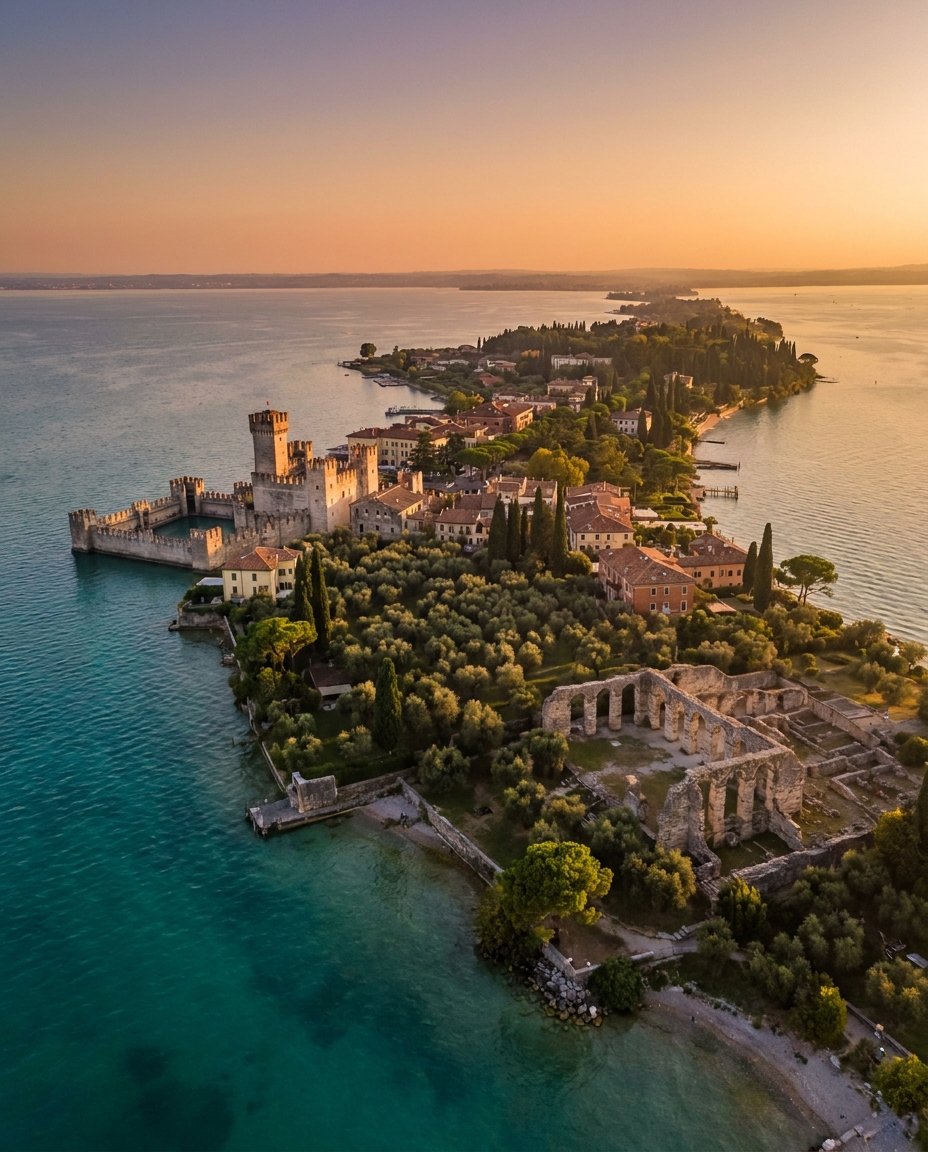
Lake Garda spans 370 km² between the gentle olive hills of the south and the steep Dolomite spurs of the north — Italy’s largest lake, and a single destination that delivers Roman ruins, theme park thrills, alpine cable cars, and one of Europe’s best windsurfing waters. Our twelve essential things to do cover Sirmione and the Catull Grottoes, Scaliger Castle, Isola del Garda, Gardaland, the Monte Baldo cable car, Malcesine Castle, Limone sul Garda, Riva del Garda, Cascata del Varone, Il Vittoriale, Punta San Vigilio and Bardolino. This guide is built for visitors planning 3 to 7 days at the lake and wanting concrete prices, opening hours and local tips rather than vague descriptions.
Quick Picks: The Top 5 at a Glance
| Attraction | Location | Entry | Time needed | Tickets |
|---|---|---|---|---|
| Sirmione & Catull Grottoes | Sirmione | €10 | 2–3 h | |
| Gardaland | Castelnuovo del Garda | from €52 | full day | |
| Monte Baldo Cable Car | Malcesine | €30 return | 3–4 h | |
| Isola del Garda | Salò (by boat) | €30 tour | 4 h | |
| Cascata del Varone | Riva del Garda | €6 | 1 h |
Table of Contents
- 1. Sirmione & the Catull Grottoes
- 2. Scaliger Castle Sirmione
- 3. Isola del Garda
- 4. Gardaland
- 5. Monte Baldo Cable Car (Malcesine)
- 6. Malcesine Castle
- 7. Limone sul Garda & the Lemon Houses
- 8. Riva del Garda — Old Town & Bastione
- 9. Cascata del Varone Waterfall
- 10. Il Vittoriale degli Italiani (Gardone Riviera)
- 11. Punta San Vigilio
- 12. Bardolino & the Wine Region
- Map: All Attractions at a Glance
- When is the best time to visit Lake Garda?
- How many days do you need at Lake Garda?
- Frequently Asked Questions (FAQ)
1. Sirmione & the Catull Grottoes

The Catull Grottoes are the largest surviving Roman villa in northern Italy — and they sit spectacularly at the tip of a narrow peninsula that juts almost four kilometres into the lake. Built in the 1st century BC, the complex spreads across two hectares of wall remains, cryptoporticoes and an ancient olive grove with more than 1,500 trees. The name is misleading: there are no real grottoes here, only collapsed vaults that medieval travellers mistook for caves. The Roman poet Catullus is recorded as having spent time at Sirmione, drawn by the hot sulphur springs that were already attracting visitors two thousand years ago. From the rocky promontory at the far end, you get a 360° view of the lake — on a clear day, all the way to Monte Baldo.
The site is open Tuesday to Sunday, 8.30am to 7.30pm, closed Mondays. Entry costs €10, reduced €2. Cars cannot enter the historic old town — park at Parcheggio Sirmione (around €15 a day) and walk 15 minutes through the village. From the entrance to the Grottoes, an 800 m path winds through the olive grove. The Scaliger Castle stands at the entrance to the old town itself, and on the way back the small 8th-century church of San Pietro in Mavino with its frescoes is well worth a stop.
Tip: Arrive before 10am or after 5pm. At midday the peninsula is overcrowded and shade is in short supply.
2. Scaliger Castle Sirmione

The Rocca Scaligera is one of the few castles in Europe with its own fully preserved harbour — the so-called Darsena, where the Scaligeri fleet once moored. The Scaligeri family from Verona built the fortress in the 13th century to control the southern end of the lake. Characteristic of the structure are the swallow-tail merlons, the symbol of the Ghibelline (pro-Emperor) faction. The castle seals off the peninsula completely — anyone heading into the historic centre has to cross the single bridge. From the Mastio, the 47 m main tower, you look across the whole lagoon and the village rooftops.
Open Tuesday to Sunday, 8.30am to 7.30pm, closed Mondays. Entry €6, reduced €2. Allow around an hour; the 146 stairs up to the Mastio are narrow. The castle pairs perfectly with the Catull Grottoes for a single half-day — both sit on the same peninsula. The free lakeside path starting right outside the castle leads toward Jamaica Beach, a shallow rock platform near the Grottoes that is one of the lake’s most famous swimming spots.
Tip: The castle’s harbour basin is freely accessible from the outside — a photo hotspot at sunset when the battlements glow orange.
3. Isola del Garda

Isola del Garda is the lake’s largest island — around 1 km long — and is still owned by the Cavazza-Borghese family. In the 15th century Franciscan monks lived here, and Saint Francis of Paola later visited the rock. The present palazzo was built between 1890 and 1903 in a Venetian neo-Gothic style: a fairy-tale palace with pointed-arch windows, turrets and a vast winter garden. Formal Italian terraced gardens descend toward the water, planted with cypresses, lemon trees, hydrangeas and rare subtropical species. An English landscape garden completes the grounds at the rear of the property.
The island is accessible only by reservation-only guided boat tours run by the Cavazza family — departures from Salò, San Felice del Benaco, Manerba, Gardone Riviera, Garda and Barbarano. Depending on the port, the tour lasts between two and four and a half hours and costs €30 to €38, including a guided tour of the gardens, a walk through the palazzo and an aperitif on the terrace. Booking 1 to 2 weeks ahead is strongly advised; in peak season tickets often sell out days in advance. Season runs from late March to early October.
Tip: Book a tour from Salò — the crossing cuts directly through the most scenic part of the lake and only takes 15 minutes.
4. Gardaland (Italy’s Biggest Theme Park)

Gardaland is Italy’s largest theme park, opened in 1975 in Castelnuovo del Garda. Today it has more than 50 attractions, headlined by the wooden coaster Jumanji – The Adventure (2022), the water-driven Raptor, the Kung Fu Panda Academy themed ride and the classic Magic Mountain. The park is divided into themed worlds covering the Middle Ages, the Wild West, the Caribbean and a fairytale forest. The wider complex includes three themed hotels — Gardaland Hotel, Adventure Hotel and Magic Hotel — plus the adjacent Sea Life Aquarium and the LEGOLAND Water Park (opened 2021).
Entry from €52 for adults if booked online; gate prices reach €60 and beyond. Express Pass skip-the-line tickets cost an additional €25 to €45 and absolutely earn their price in peak season — at the headline rides you save 1 to 2 hours of queueing per attraction. Getting there: A4 motorway, Peschiera del Garda exit; paid car parks line the park entrance. The season runs from late March to early January, with Halloween Magic (October) and Christmas Magic (December) as the standout events. Our full ticket breakdown lives at Gardaland Tickets & Skip-the-Line.
Tip: Arrive at the 10am opening and head straight for Jumanji and Oblivion — the queues for both build fast after the first hour.
5. Monte Baldo Cable Car (Malcesine)

The Funivia Malcesine-Monte Baldo is an engineering rarity: its round rotor cabins make a full 360° rotation during the ride, so every passenger gets a complete panorama without changing seats. In ten minutes the lift climbs from 65 m at the lakeshore to 1,760 m at the Tratto Spino mountain station. The change in vegetation is dramatic — olive trees and cypresses below, alpine meadows with rare gentians and orchids above. On a clear day you can see the entire lake, the Adamello group, the Brenta Dolomites and, on the very best days, as far as the Apennines.
A return ticket costs €30 for adults, a single €22 (useful for hikers walking back down to the lake). Operating hours run daily from 8am to 6pm, extended in summer. Mountain bikes and paragliders ride along — Monte Baldo is Italy’s most popular paragliding spot, with the launch platform a five-minute walk from the upper station. In winter (December to March) the mountain becomes a small ski resort with around 12 km of pistes. The Tratto Spino restaurant at the top serves hot food with a lake view.
Tip: Take the first cabin at 8am — the mountain is empty, the morning light is ideal for photos, and clouds typically build around the summit from 10am onwards.
6. Malcesine Castle

The Castello Scaligero of Malcesine sits on a rocky promontory directly above the lake and ranks among the most photogenic castles in Italy. The site dates back to the Lombards in the 6th century, with the current structure built by the Scaligeri in the 13th and 14th centuries. The castle owes much of its fame to Goethe: in 1786, the poet was arrested here on his Italian Journey after locals mistook his sketching of the walls for the work of an Austrian spy. He recounts the episode in detail in his travel diary. The Mastio now houses a small Goethe room with facsimiles of his drawings.
The castle holds three small museums: the Monte Baldo natural history museum, the Galleria della Pesca dedicated to lake fishing, and the local history museum. From the top tower you get an eagle’s view across the harbour, the medieval old town and the lake all the way to Limone on the opposite shore. Open daily from 9.30am to 7.30pm in summer, with shorter winter hours. Entry €6 for adults, reduced €3, children under 6 free. The old town with its narrow alleys and the Venetian Palazzo dei Capitani is car-free and walkable end to end in around 30 minutes.
Tip: Combine the castle with the Monte Baldo cable car — the lift’s lower station sits just 300 m from the castle, so both fit comfortably into a half day.
7. Limone sul Garda & the Lemon Houses

Limone sul Garda is wedged between a cliff face and the lake — almost the entire western shore road runs through tunnels at this point. The village is famous for its limonaie, terraced lemon greenhouses with characteristic white pillars that were covered with wooden roofs during the winter months. Limone was for centuries the northernmost commercial citrus cultivation in Europe and supplied much of central Europe with lemons during the Habsburg era. Today you can visit the Limonaia del Castèl in the centre of the village — a restored structure with lemon, orange and mandarin trees. Entry €2.
An architectural highlight nearby is the Ciclopista del Garda, a cycle path built on wooden and steel walkways cantilevered out over the water beneath the sheer cliffs. The stretch between Capo Reamol and Limone runs around 2 km, is free to use, walkable or rideable, and counts among the most spectacular waterfront paths in Europe. The old town with its narrow alleys, the parish church of San Benedetto and the well-known statue of Daniele Comboni (born here) is car-free. Park at Parcheggio Porto, around €2 per hour.
Tip: Walk the Ciclopista at sunset — the western face of the rock glows orange, and you get long views back across the lake in both directions.
8. Riva del Garda — Old Town & Bastione

Riva del Garda is the lake’s northernmost town and administratively belongs to the Province of Trento, not Lombardy or Veneto. The medieval old town around Piazza III Novembre feels far more alpine than Mediterranean — unsurprising given the sheer rockface of the Rocchetta rising directly behind it. The 33 m Torre Apponale from the 13th century stands at the harbour and can be climbed (€2, open April to October). The Rocca di Riva, a 12th-century moated castle, today houses the Museo Alto Garda with its picture gallery and archaeological collection.
Above the town stands the Bastione, a 16th-century Venetian fortress ruin perched 200 m up the cliff. You reach it either on foot in 15 to 20 minutes via a switchback path or by the inclined lift opened in 2021 (€5 return). The summit holds a restaurant with a panoramic terrace — the view stretches across the entire northern basin all the way to Garda. Riva is also Italy’s windsurfing capital: the morning Pelèr wind reliably brings 25 to 35 km/h from the north, the afternoon Ora delivers 20 to 25 km/h from the south. The Sabbioni and Spiaggia degli Olivi beaches are both free.
Tip: Have breakfast at one of the bars on Piazza III Novembre — the sun rises early over the mountains and the square wakes up to life within minutes.
9. Cascata del Varone Waterfall

The Cascata del Varone is a 98 m waterfall inside an extremely narrow vertical gorge — and a geological oddity. The water does not come from a surface stream but cascades from an underground basin fed by Lago di Tenno, 10 km away. The waterfall is more than 20,000 years old and has carved itself over 70 m deep into the rock over that time. Two accessible viewing platforms — one at the lower grotto, one at the upper — bring you within metres of the thundering column of water. It is loud, wet and surprisingly powerful.
Open daily 9am to 5pm (May to August until 7pm), with weekends only during winter. Entry €6 for adults, €4 reduced, €3 for children. From Riva del Garda the site is around 3 km uphill — 5 minutes by car, around 45 minutes on foot. Paid parking sits right at the entrance. Allow just under an hour for both platforms. In summer the gorge is refreshingly cool — a welcome contrast on hot days. Solid shoes are recommended as the walkways can be wet and slippery.
Tip: Combine the Cascata with nearby Lago di Tenno — a turquoise mountain lake just 8 km further up the road.
10. Il Vittoriale degli Italiani (Gardone Riviera)

Il Vittoriale degli Italiani in Gardone Riviera is one of the most idiosyncratic estates in Italy — the curated home of poet, war hero and aesthete Gabriele D’Annunzio (1863–1938). D’Annunzio was gifted the property by the Italian state in 1921 and spent the rest of his life turning it into a 9-hectare total work of art. Highlights: the warship Puglia, whose entire bow Mussolini had transported up the hillside and embedded in the slope; the mausoleum on the highest point of the grounds with its raised sarcophagi; the two-tier open-air theatre; and most of all the Prioria, D’Annunzio’s residence, packed with more than 33,000 objects — books, statues, religious relics and gifts from heads of state.
Entry €20 for the full ticket (park, Prioria and museums), park-only €12. Open daily 9am to 7pm in summer, until 5pm in winter. The Prioria can only be visited on timed-entry guided tours, and reservation is strongly recommended. Allow 3 to 4 hours for the site. D’Annunzio is a politically polarising figure — a forerunner of Italian fascism as much as one of the most celebrated poets in the language — and the Vittoriale does not hide this. Architecturally and culturally, the estate has no real parallel in Europe.
Tip: Book the Prioria tour online in advance — slots regularly sell out days ahead in peak season.
11. Punta San Vigilio

Punta San Vigilio is a small private peninsula between Garda and Torri del Benaco — and one of the most idyllic spots on the entire lake. In the 16th century, the Veronese nobleman Agostino Brenzone commissioned the architect Michele Sanmicheli to build a country residence here: the Villa Brenzone, with the private chapel of San Vigilio and the still-operating Locanda San Vigilio, a historic inn that has hosted Winston Churchill, Laurence Olivier and Prince Charles. The small harbour with its cypresses, the olive grove and the traditional rowing boats together create the postcard image of the lake.
Right next door lies the Baia delle Sirene — one of the few genuine fine-pebble bays on the eastern shore, fringed by old olive trees that reach down to the water. Beach access is paid: €15 on weekdays, €25 at weekends in peak season, including a sun lounger and umbrella. The harbour area, the chapel and the olive-grove promenade are all free. From the Garda car park it is a 15-minute walk, or you can drive directly to the harbour (limited spaces, €5 per hour). Open April to October; the Locanda closes for winter.
Tip: Stop by for an evening aperitif at the Locanda — the harbour view in sunset light is genuinely unforgettable.
12. Bardolino & the Wine Region

Bardolino on the eastern shore is the centre of the eponymous DOC wine region and has produced wine since Roman times. Bardolino DOC is a light, fruity red made from Corvina, Rondinella and Molinara grapes — the same blend as the more famous Valpolicella, but lighter in body and lower in alcohol. The hilly moraine landscape behind the village is perfectly suited to viticulture: chalky soils and a mild microclimate created by the lake. Well-known wineries including Zeni, Guerrieri Rizzardi, Cavalchina and Le Fraghe offer tastings from €10 a head, some with cellar tours and olive-oil tastings alongside.
The Strada del Vino Bardolino is a signposted wine route running for 80 km through 16 wine-producing communes, dotted with cantine and agriturismi. The village itself rewards a stroll: the church of San Severo (9th to 11th century, with surviving frescoes) and the palm-lined lakeside promenade. The annual highlight is the Festa dell’Uva e del Vino, the grape and wine festival in early October, with tastings, live music and the traditional crowning of the wine queen. Getting there: A4 motorway, Affi exit, then 5 km down to the lake. Parking at the harbour costs €1.50 per hour, around €12 for the full day.
Tip: Wednesday is market day in Bardolino — the biggest market on the whole eastern shore, with local cheeses, salami and olive oils straight from the producers.
Map: All Attractions at a Glance
The twelve attractions are spread across all four shores of the lake. Sirmione and Gardaland anchor the south, both within easy reach of Verona and Brescia. Salò, Gardone Riviera and Isola del Garda dominate the middle of the western shore. Limone sul Garda and Riva del Garda, together with the Cascata del Varone, form the northern end of the lake. The eastern shore runs from Malcesine and the Monte Baldo cable car in the north down through Punta San Vigilio to Bardolino in the south.
When is the best time to visit Lake Garda?
May and June are our top picks: mild weather around 22–26 °C, wildflowers in full bloom, the lemon trees in fruit, and the Italian school holidays don’t start until mid-June, so beaches remain uncrowded. Water temperature sits at 20–22 °C, plenty warm enough for swimming.
July and August are peak season with consistent 30 °C+ days and occasional spikes to 35 °C. Water temperature rises to 24–26 °C, ideal for long swims. Every attraction, restaurant and bar is open, but hotel rates run 30–50% higher than off-season and the popular towns are genuinely crowded. Book tickets and restaurants well in advance.
September to mid-October is our second recommendation: the water stays warm at 22–24 °C, the heat eases, and the wine harvest in Bardolino brings a string of festivals. After 15 October many restaurants and seasonal hotels close for winter.
November to March is low season: Gardaland, Cascata del Varone and Isola del Garda all close, and many hotels take a winter break. What still works: Sirmione with its thermal baths (Aquaria and Terme di Catullo), south-shore hiking, skiing on Monte Baldo (December to March) and olive-harvest visits at the local frantoi.
How many days do you need at Lake Garda?
2 days is enough for the southern highlights only: Day 1 Sirmione with the Grottoes and Scaliger Castle plus a Bardolino sundowner, Day 2 either Gardaland (for families) or a boat tour to Isola del Garda (for couples and culture travellers). You will get a slice of the lake but miss the more dramatic northern shore.
3 to 4 days is our minimum recommendation: the south plus the eastern shore including the Monte Baldo cable car and Malcesine Castle. Use Day 3 for Punta San Vigilio and the Bardolino wine region, and optionally Day 4 for a day trip to Riva del Garda and the Cascata del Varone.
5 to 7 days covers the entire lake: add the western shore with Il Vittoriale at Gardone Riviera, Limone sul Garda with its lemon houses and the Ciclopista, plus enough breathing room for unplanned beaches, boat trips and slow evenings. For a full week we recommend splitting your base: 3 nights in the south (Sirmione or Bardolino) and 4 nights in the north (Riva del Garda or Malcesine).
More than 7 days opens up day trips to Verona (45 minutes by car), the Brenta Dolomites or Lake Iseo. A second day in Valpolicella or Soave wine country is also worth it. Our straightforward advice: plan a minimum of 3 days. With less than that, you spend more time commuting than at the lake itself.
Frequently Asked Questions (FAQ)
What is the must-see attraction at Lake Garda?
The three non-negotiable stops are Sirmione with the Catull Grottoes (history, architecture and natural beauty all packed onto one peninsula), the Monte Baldo cable car from Malcesine (the best panorama of the entire lake, reached in 10 minutes) and Isola del Garda with its neo-Gothic palazzo and gardens (a unique island visit, accessible only via guided tour). With more time, add Riva del Garda for its alpine character and Gardaland if you are travelling with kids.
Which is the most beautiful town at Lake Garda?
It depends on taste, but our ranking: Sirmione wins on uniqueness — the peninsula setting, the castle and the Roman history make every angle photogenic. Malcesine has the loveliest medieval old town directly on the lake, with car-free alleys and a castle on the water. Limone is the most dramatically positioned, sandwiched between cliff and lake. Riva del Garda in the north is the most varied — old town, mountains, harbour promenade and a windsurfing scene all meet in one place.
What can you do at Lake Garda when it rains?
There are more indoor options than you might expect: Il Vittoriale in Gardone Riviera (covered house tours), the Sirmione thermal baths Aquaria Spa and Terme di Catullo, Gardaland (many covered attractions plus the Sea Life Aquarium), wine tastings at the Bardolino cellars, the Olive Oil Museum in Cisano (free entry), the Museo Alto Garda in Riva, the natural history museum inside Malcesine Castle, and the many frescoed churches in Sirmione, Bardolino and Garda.
Is Gardaland worth it for adults?
Yes, with caveats. Anyone who likes serious coasters gets full value from Mammut, Oblivion, Raptor and Blue Tornado — the line-up is internationally competitive. For adult-only groups, the themed weeks work best: Halloween Magic (October) and Christmas Magic (December) skew less family-heavy and have more atmosphere. Skip-the-line passes pay for themselves from mid-June onwards. For calmer culture travellers, Gardaland is the wrong day out — choose the Vittoriale or the wine region instead.
How do you get to Isola del Garda?
Only via guided boat tours run by the Cavazza-Borghese family, who still own the island. Departures leave from six ports: Salò, San Felice del Benaco, Manerba, Gardone Riviera, Garda and Barbarano. Tours last 2 to 4.5 hours depending on the port and cost €30 to €38. Reservation 1 to 2 weeks ahead is strongly advised, and in peak season tours often sell out days in advance. Included are the guided garden tour, a walk through the palazzo and an aperitif on the terrace. Season runs from late March to early October.
Which Lake Garda attractions are free?
A whole string of worthwhile sights cost nothing: the harbour area at Punta San Vigilio with the Locanda and chapel, the old town and harbour promenade of Riva del Garda, the medieval centre of Malcesine (the castle itself is paid), the entire waterfront and lemon-house exteriors in Limone, the harbour at Bardolino, the Sirmione peninsula up to the entrance of the Grottoes, the Ciclopista del Garda walkway between Limone and Capo Reamol, and free beaches such as Sabbioni at Riva, Jamaica at Sirmione and Lido di Cisano.
How much does a day at Lake Garda cost?
For one mid-range traveller, budget around €90 per day: breakfast at a bar €8, light lunch €18, dinner at a trattoria €30, one paid attraction €15 (castle or waterfall), a boat trip or ferry €10, and around €10 for parking. A 3-star hotel double room runs €70 to €120 depending on season and location. The western shore (Limone, Malcesine) prices 10 to 20% higher than the east (Bardolino, Garda). In peak July and August, hotel rates climb by up to 50% over off-season levels.
Related Guides
- Boat Rental at Lake Garda — Complete Guide — the full hire guide with Click&Boat providers
- Gardaland Tickets & Skip-the-Line — ticket types, hotel packages, getting there
- Lake Garda Wedding Guide — venues, planners and legal paperwork
- Things to Do in Sirmione — the complete Sirmione town guide
- Things to Do in Malcesine — Monte Baldo, castle, windsurfing
- Riva del Garda Complete Guide — the northern lake in detail
Lake Garda is far more than Sirmione and Gardaland. Anyone who sticks to the famous southern hotspots misses the alpine drama of the north, the quiet lemon houses of Limone, the exclusivity of Isola del Garda and the wine country behind Bardolino. Our clear advice: explore the northern and western shores as well — that is where the scenic variety lies that sets Lake Garda apart from any other lake in Italy. To experience the best things to do at Lake Garda in 2026 without stress, book tickets and hotels well in advance — particularly for the July and August peak. Compare activities and tickets before you go.